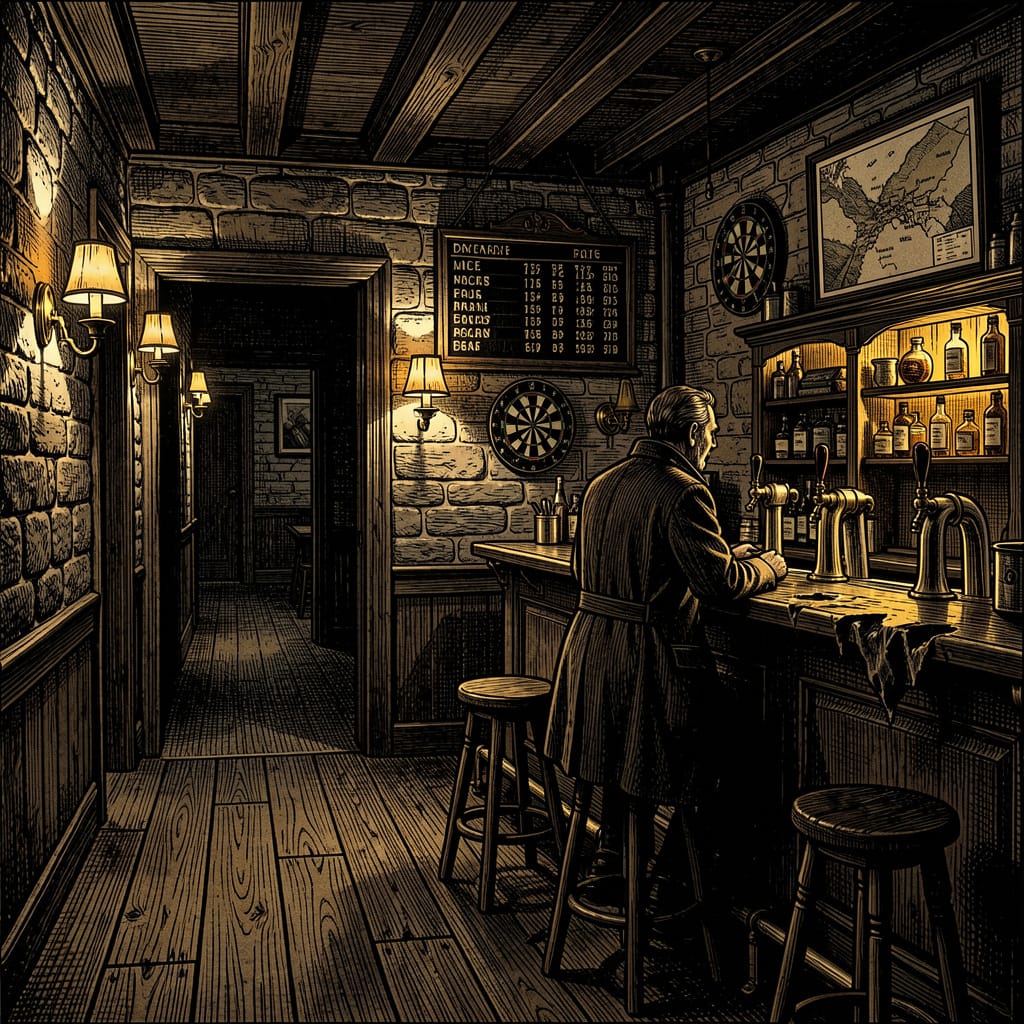
Quietly, and known to very few, the pub is an informal rally point for Beowulf in the valley, and Mick Hargreaves is a long-standing asset whose ordinary-publican exterior covers a professional history of another kind. Its bar is a neutral floor where two men can speak without drawing the notice a private meeting would — information moving across it as freely as the beer.
It is here, in Chapter Ten: Beautiful Lie, that Declan Marsden and Mick hold their first exchange after Robert's manifestation. Mick reports the watching he has clocked from behind his taps: a silver Audi and a white van with a satellite dome on School Lane, plates swapped each visit; the camera-man identified by his petrol-station credit card as Phillip Lawson, a former signals man; photographs taken of the old bike shed; and a low-power relay set up near Edale Cross, positioned to bounce a signal to Manchester — listening, not talking. Mick reads Lawson not as a passive watcher but as a man building a case, and warns that the withdrawal of the van means little:
Orion doesn't give up. They just get quieter.
— Mick Hargreaves, Cambion, Chapter Ten.
Before Declan leaves, Mick slides a tea towel across the bar; beneath it sits a scrambler-equipped Motorola brick, stubby-antennaed and heavy, that runs hot even idle — charge it every night, press nine to call out — with the reminder of Protocol Shepherd. The exchange sets Declan's footing for the phase that follows, and frames the difference the two men are on the same side of:
That's the difference, isn't it? We maintain the lie. They want to make it truth.
— Mick Hargreaves, Cambion, Chapter Ten.
The pub recurs across the book as the place these quiet, consequential conversations happen — Mick behind the taps, the village none the wiser.